
Columbia County Court Records After a Jail Arrest
An arrest in Columbia County sets off a chain that ends in a court record. A deputy, a Lake City police officer, or another local agency makes the arrest. The person is taken to the Columbia County Detention Facility and booked. If the person cannot bond out, a judge holds a first appearance within 24 hours by Zoom and states the charge and bond. Then the Third Judicial Circuit State Attorney reviews the arrest and decides what to file. The charges the prosecutor files open the case. That case, kept by the Clerk of Court, is the court record people search for after an arrest.
The booking side and the court side are two different records. Booking charges, mugshots, bond, and custody status live on the jail roster, which you reach through the Columbia County jail inmate records page, while booking photos are covered on the jail roster mugshots page. The court record is the filed case: the charges the prosecutor chose, the filing dates, court dates, docket entries, and the final outcome. A person can be arrested on one charge and end up facing a different charge in court, or none at all. That gap is why court records after an arrest matter so much.
How to Find Columbia County Court Records After an Arrest
Filed charges and case status show up in the Clerk of Court index, not on the jail roster. The Columbia County Clerk runs a court search built on the Civitek public access system. You start at the Clerk landing page, accept the access notice, then run a Person Search by name. Add a date of birth when the name is common. The roster is the place to confirm the booking date and any case number, but the Clerk index is where the actual court charges, court dates, and outcomes appear.
The county roster opens through the Columbia County Clerk court search, which presents a public access notice before the search form.
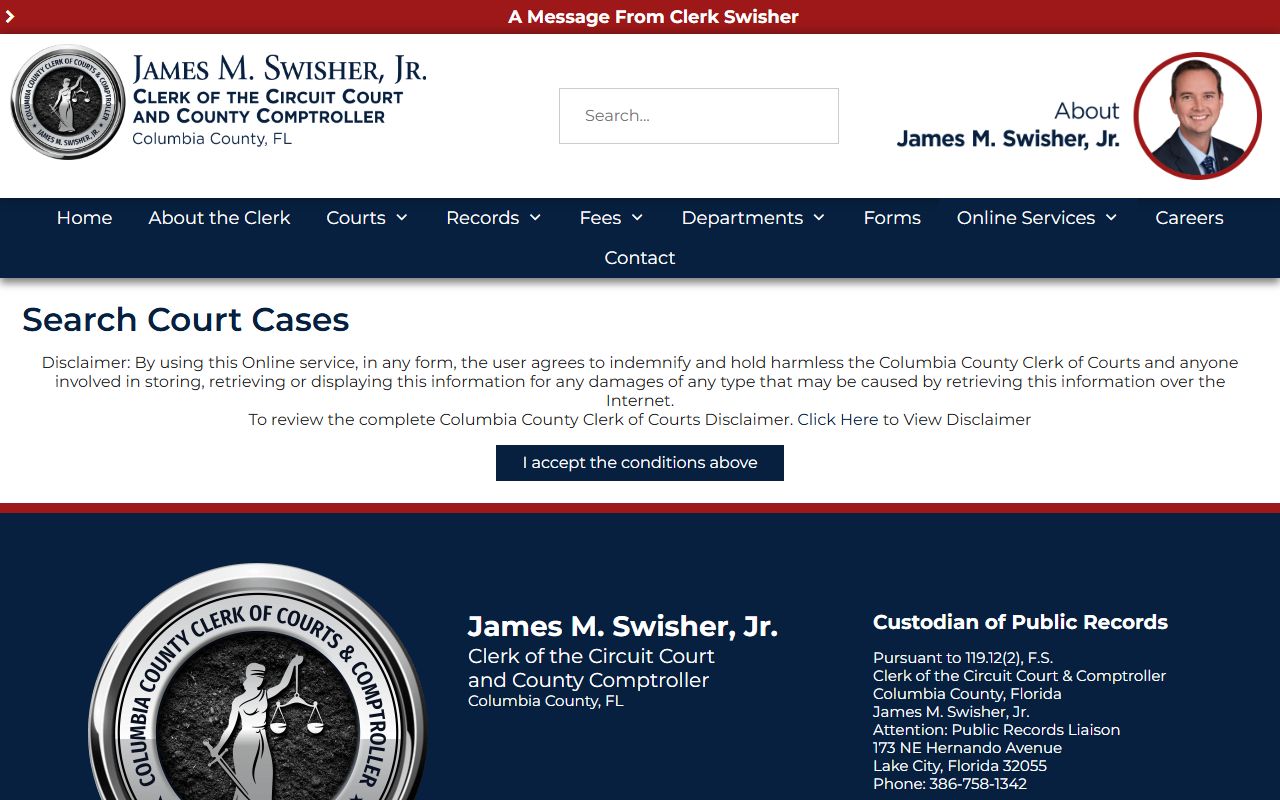
After you accept the notice, the search lets you look up a defendant by last and first name or by case number.
- Open the Columbia Clerk court search page and accept the public access notice.
- Run a Person Search by the defendant's last name and first name, and add a date of birth if the name is common.
- Open the matching case and read the full charge list.
- Check each charge for its statute code, level, court type, and current status.
For charges and history beyond the county, statewide lookups help. The Florida Department of Law Enforcement runs a criminal history record request service for a full statewide background. Sealed or expunged records are handled through the FDLE seal and expunge process. Florida Statutes section 119.01 keeps county and court records open for inspection unless an exemption applies.
How Charges Get Filed After a Columbia County Arrest
The court record starts with a charging document. After the arrest and booking, the State Attorney reviews the case and files the paper that turns an arrest into a court charge. Florida uses three main charging documents, and the one used depends on how serious the charge is. A complaint or affidavit supports the arrest itself. For most cases that go forward, the prosecutor files an information. A grand jury returns an indictment for the most serious felonies. Each one opens a case in the Clerk's system and becomes part of the court record after an arrest.
| Complaint | Information | Indictment | |
|---|---|---|---|
| Filed By | Officer / Prosecutor | State Attorney | Grand Jury |
| Common For | Misdemeanors and arrest support | Many felonies and misdemeanors | Serious felonies |
| Starts | The case | The case | The case |
The Civitek public access search for Columbia County lets you open a case and see which document was filed and what charges it carries.
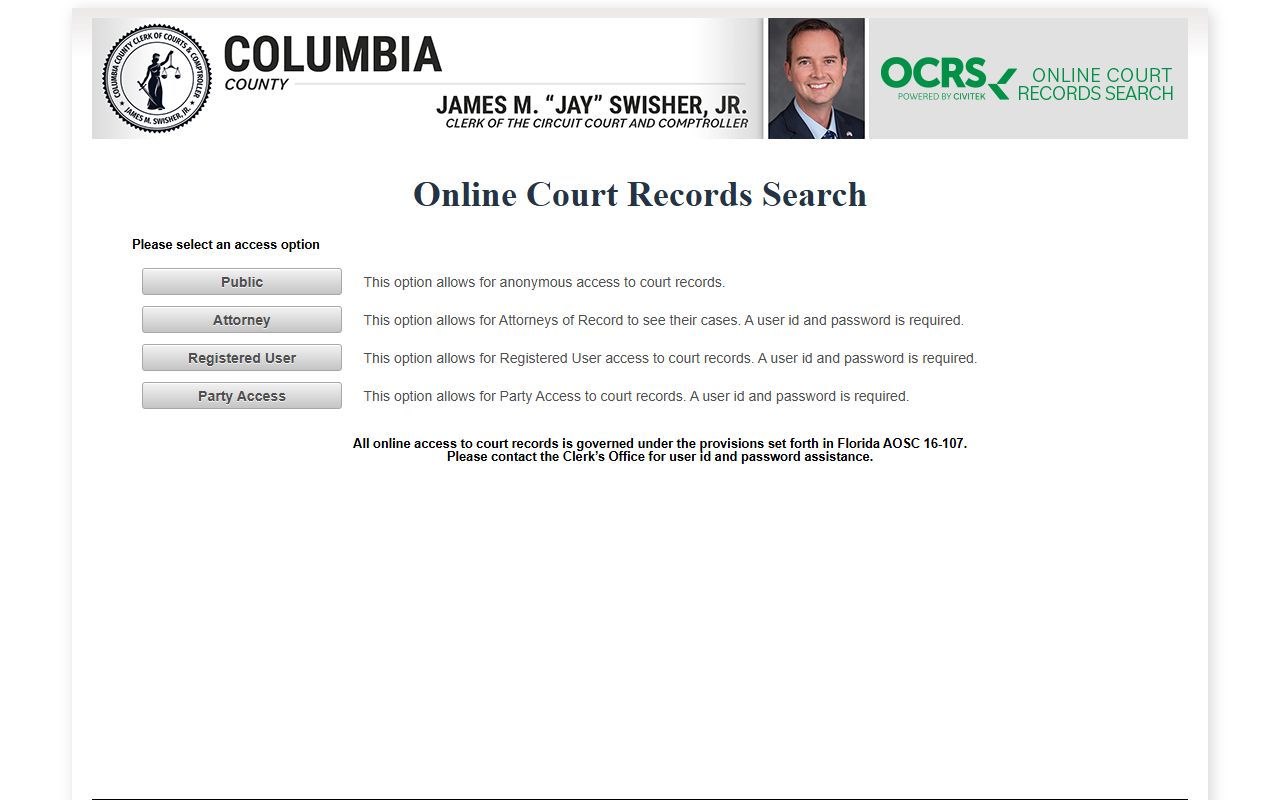
The search runs a Person Search by name, with filters for date of birth and court type so you can sort felony, misdemeanor, and traffic cases apart.
| Field / Control | Notes |
|---|---|
| Public access selector | Anonymous public access; no login needed for a name search. |
| Last Name | Required for a defendant Person Search. |
| First Name / MI | Optional; narrows common names. |
| Date of Birth | Optional MM/DD/YYYY; useful for common names. |
| Date Case Filed range | Optional MM/DD/YYYY From and To filters. |
| Court Type CF / MM / CT | Felony, misdemeanor, and criminal traffic filters. |
Note: The Clerk of Court is James M. Swisher, Jr., at 173 NE Hernando Ave., Lake City, FL 32055, reachable at 386-758-1342 for case records the search does not show.
Charge Status and What It Means
Charges change as a case moves through court. The status field tells you where a charge stands right now. A charge can be added, amended, reduced, dropped, or carried to a verdict. This is the key reason booking charges on the jail roster can differ from the charges the prosecutor finally files. The roster shows what a person was arrested for. The court record shows what the State Attorney chose to pursue and how the court ruled. The terms below appear often in Columbia County case dockets.
| Status | What It Means |
|---|---|
| Pending | The charge is active and the case is still moving through court. |
| Amended / Reduced | The charge was changed from the first filing, often to a lesser charge. |
| Dismissed | The charge ended by court or prosecution action and is not being pursued. |
| Nolle Prosequi | The prosecutor chose not to go forward on the charge. |
Note: Booking charges can drop off while new charges are filed, so always read the court case, not just the jail roster, to learn the current charge status.
Bond and Release After an Arrest
Bond is set early, usually at first appearance. Columbia County holds first appearance each day by Zoom at the jail, and the judge states the charge and the bond amount for each count. Bond, also called bail, is money or a promise meant to make sure the person comes back to court. Florida Statutes section 903.046 lists what a judge weighs when setting bail, such as the offense, ties to the area, work, finances, past record, and any danger to the community. Section 907.041 allows a court to order a person held without bond for the most serious cases or a clear flight risk.
| Bond Type | How It Works |
|---|---|
| Cash Bond | The full amount is paid directly as the court and jail require. |
| Surety Bond | A licensed bail bond agent posts the bond on the person's behalf. |
| PR / Own Recognizance | The court releases the person on conditions and a promise to appear, with no full cash payment. PR means personal recognizance. |
| No-Bond Hold | No bond is set, or a hold for another agency blocks release until the court or that agency acts. |
Posting money on one charge may not free a person who has more than one charge, a bond revocation, or a hold. A hold, also called a detainer, is a request from another authority that keeps the person in custody. Bond amounts and orders show up in the court case docket, so the Clerk record is the place to confirm a current bond after first appearance.
Warrants That Lead to a Columbia County Arrest
Many arrests start with a warrant. A judge issues an arrest warrant when there is probable cause that a crime was committed, under Florida Statutes section 901.02. Section 901.04 directs that warrant to sheriffs across the state, so it can be served in any county. A bench warrant is a court order, often for a missed court date. When a warrant is served, the person is booked, and the case can then show up in the court record.
The Columbia County Sheriff's Office Warrants Division keeps and serves county warrants, but it does not release warrant information to the public. For an open warrant, the state tool is the place to look. The Florida Department of Law Enforcement runs the Public Access System, and its Wanted Persons search covers people sought by Florida agencies. FDLE warns the public not to act on a listing and to contact law enforcement instead. Court cases in the Clerk index can also show bench warrants, capias entries, and failure-to-appear notes tied to a filed case.
Charges vs. Convictions in Court Records
An arrest and a charge are not a conviction. A charge is an accusation. A conviction is a final result reached by a plea or a verdict. Court records after an arrest may show a charge that is still pending, one that was dropped, or one that ended in a conviction. Reading the disposition, the outcome line, tells you which it is. Treating a charge as guilt is both unfair and, for many uses, against the law.
| Charge | Conviction | |
|---|---|---|
| Stage | Accusation | Verdict or plea |
| Burden of Proof | Probable cause | Beyond a reasonable doubt |
| Public Record | Yes | Yes |
The State Attorney drives that gap between charge and conviction. The prosecutor can file, amend, reduce, or drop charges, and the court decides the final outcome.
The Third Judicial Circuit handles this work for Columbia County, and its public site explains the prosecutor's role.
You can learn more about the office through the Third Judicial Circuit State Attorney homepage, which names the current State Attorney and the records custodian.
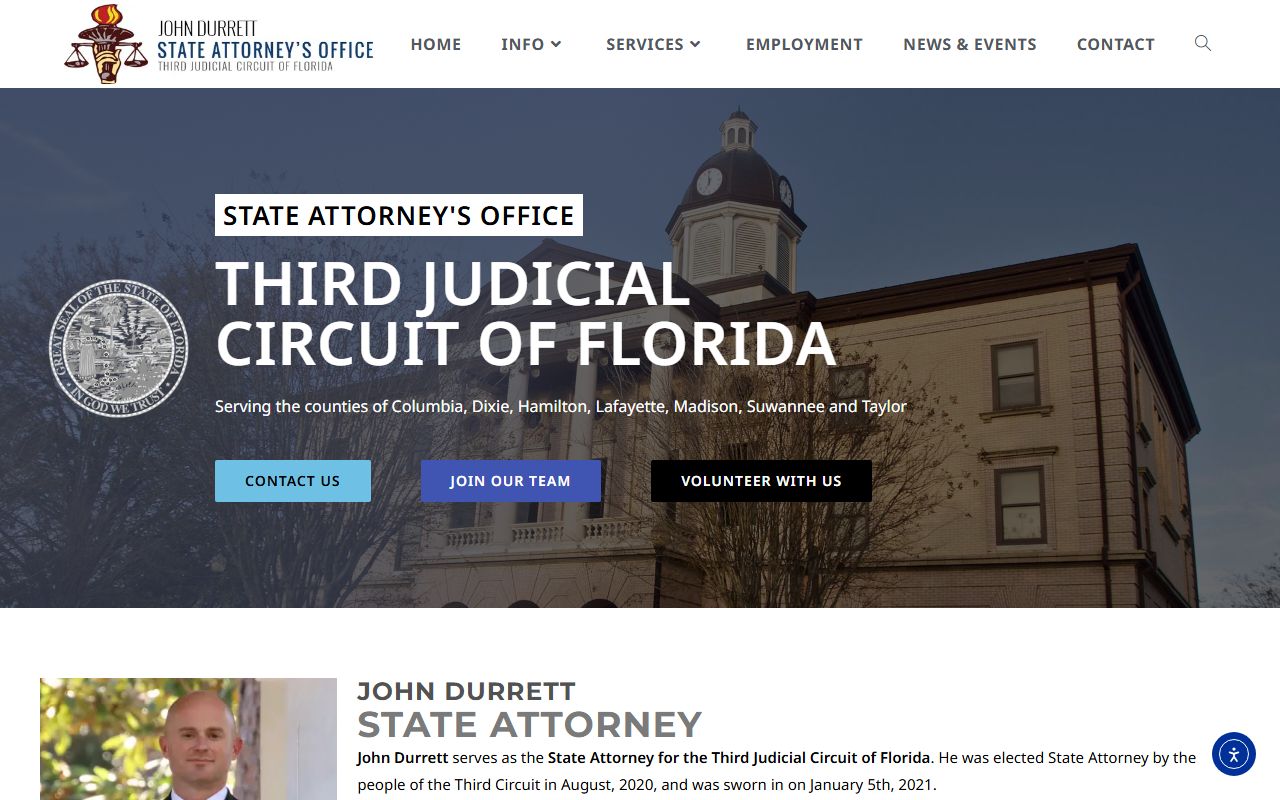
The State Attorney decides what charges to file after a Columbia County arrest, so the court record reflects the prosecutor's choices, not just the booking charges.
Sealed vs. Expunged Arrest Records
Florida lets some people clear an arrest record after a dismissal or another qualifying outcome. There are two paths, and they are not the same. Sealing, under Florida Statutes section 943.059, hides the record from public view but keeps it for limited official use. Expunction, under section 943.0585, goes further and orders the record destroyed or treated as if it never existed. Both start with a certificate of eligibility from FDLE, and relief is not effective until FDLE receives a certified court order from the proper court.
| Sealed | Expunged | |
|---|---|---|
| Visibility | Hidden from public | Destroyed / treated as never existed |
| Law Enforcement | Limited access | Very limited |
| Eligibility | FL §943.059; certificate of eligibility from FDLE | FL §943.0585; often after a dismissal or no charges filed |
Note: A sealed or expunged record can stay out of public view, so a court search may show nothing even when an arrest once happened.
Background Check Considerations
A casual court search is not the same as a formal background check. Looking up a single case in the Clerk index is a free public records task. A formal background check used for hiring or housing is governed by the federal Fair Credit Reporting Act, the FCRA, and must run through a regulated consumer reporting agency. For a full statewide history, the FDLE criminal history service is the official source, and a Columbia County local check runs through the Sheriff's Office records unit. Court records after an arrest can be incomplete, so verify a result with the Clerk before acting on it.
Important: This site is not a consumer reporting agency under the FCRA, and nothing here may be used to decide employment, housing, credit, insurance, or any other FCRA-covered purpose.
Restricted Court Records After an Arrest in Columbia County
Not every record tied to an arrest is open. Florida keeps most arrest and court records public under Chapter 119, but several kinds are restricted. Juvenile records carry tighter access rules. Sealed and expunged cases drop from public view. Active criminal investigative information can be withheld under Florida Statutes section 119.071 until the case reaches the required stage. Protected victim details and some medical or security information may also be redacted. When a court search comes up empty, one of these rules, not a missing case, may be the reason. For records that are exempt or simply not online, the Clerk's office and the State Attorney are the offices to ask.